Custom Visitor Badges for Offices, Schools and Events: What to Include
What to print on custom visitor badges, what to leave off, how to color-code and number them, and when reusable PVC badges make sense.
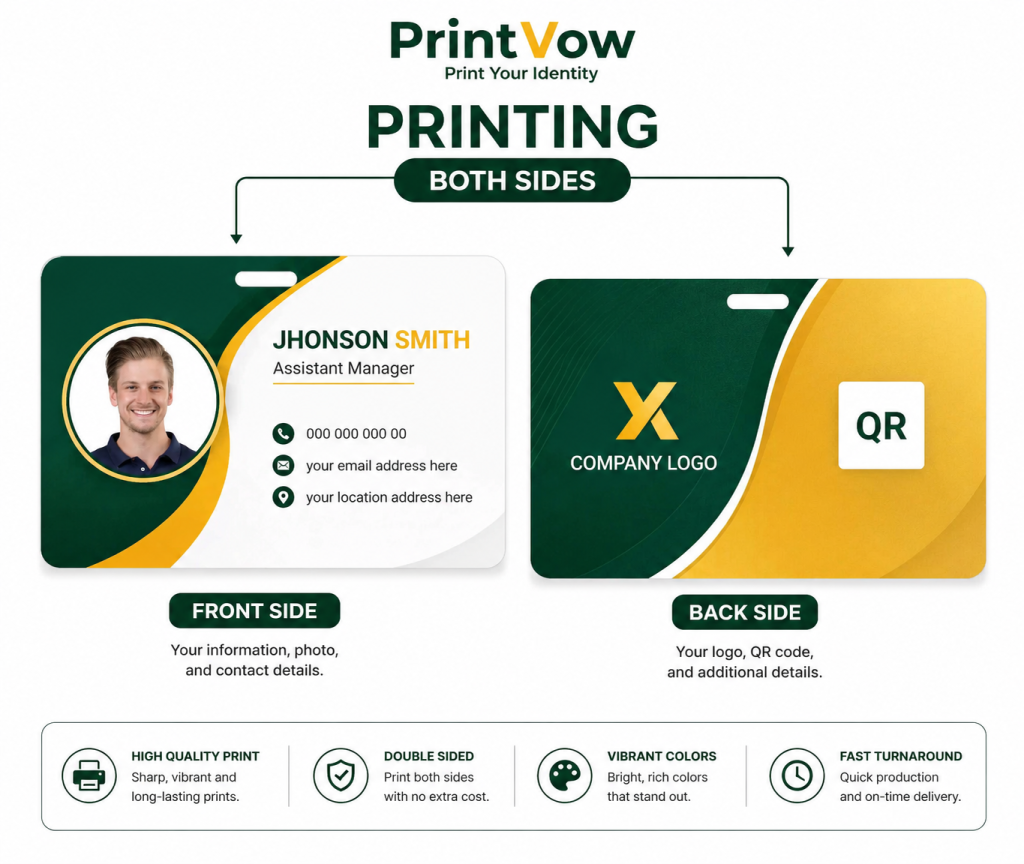
A good custom visitor badge does one job: it lets anyone see at a glance that a person is a guest, and what they are allowed to do. Keep it simple. Print a large word like VISITOR, your logo, a color for the visitor type or zone, and a badge number. Leave off names, photos and other personal details. If you check in visitors every day, reusable PVC badges that you hand out and collect back are often easier than printing a new sticker each time.
Below is what to print, what to skip, and how to set up a simple sign-out system so the badges come back.
Quick answer
- Print: a big visitor-type word (VISITOR, CONTRACTOR, VENDOR), your logo, a color band, and a unique badge number.
- Optional: “Must be escorted”, an area or zone name, a short return note on the back (“Please return to front desk”).
- Don’t print: the visitor’s name, photo, company, phone number or any other personal data on a reusable badge.
- Color: pick one color per visitor type or zone, use it the same way everywhere, and post a key at reception.
- Wear: on a lanyard or clip, at chest height, so staff can see it without asking.
- Process: log the badge number next to the visitor’s name at check-in, and match it again at check-out.
Reusable PVC visitor badges vs printed paper stickers
There is no single right answer. It depends on how many visitors you get and how much you care about knowing who is in the building.
Reusable PVC badges
Pros:
- Sturdy. They hold up to daily handling and can last a long time at the front desk.
- Look professional and are hard to copy quickly with a home printer.
- Numbered badges make it easy to see if one is missing at the end of the day.
- No per-visitor printing, so check-in is fast.
Cons:
- Badges walk out the door. You need a return habit (see below).
- They don’t show the visitor’s name, so staff have to check the log to know who someone is.
- They should be wiped down between users.
- If a badge is lost, it should be marked as inactive in your log.
Paper stickers or printed self-expiring passes
Pros:
- Can show the visitor’s name, host and date.
- Nothing to collect at the end of the visit.
- Pair well with visitor management software that prints a label at check-in.
Cons:
- Ongoing cost of labels, printer and ink.
- Easy to copy or reuse if they don’t show a date.
- Peel off clothing and look less formal.
Many sites use both: reusable PVC badges for contractors and regular vendors, and stickers for one-time guests. Schools and small offices with a paper sign-in book often prefer numbered PVC badges because they are simple and don’t need software.
What to print on a visitor badge
1. The visitor type, large and clear
The most important thing on the badge is one word that can be read from across a hallway. Common options:
- VISITOR
- CONTRACTOR
- VENDOR or DELIVERY
- VOLUNTEER
- ESCORT REQUIRED
- GUEST or VIP (for events)
Use bold, simple letters. Avoid script fonts. If you have room, print the word on both sides so it still reads correctly when the badge flips on a lanyard.
2. Your logo and site name
A logo shows the badge belongs to your building and makes it harder to fake. For schools, the school name is helpful for substitute staff and parents. Keep the logo smaller than the visitor-type word so the word stays the main thing people see.
3. A color band
A thick band of color across the top or bottom lets staff identify the badge type even when the text is hard to read. More on choosing colors below.
4. A unique badge number
Numbers turn a stack of identical badges into something you can track. A simple pattern works best:
- V-001 to V-050 for visitors
- C-001 to C-020 for contractors
- VEN-001 and up for vendors
Print the number on the front so it can be checked at the door, and again on the back if you use double-sided cards. Write the number next to the visitor’s name in your sign-in log. At the end of the day, any number without a return time is a missing badge.
5. Optional extras
- Zone or floor access, for example “Floors 1-2 only”
- “Must be escorted at all times”
- A return line on the back: “Please return this badge to reception when you leave”
- A phone number for reception if found (use a main office line, never a personal one)
Bring Your Ideas to Life
Create custom wristbands, can coolers, lanyards and more for your next event, promotion or organization. No minimum order on most products.
Shop Lanyards & PVC ID →What NOT to print on a reusable visitor badge
Reusable badges are passed from one person to the next, so nothing about a single person should be printed on them. Leave off:
- Visitor names or photos
- Personal phone numbers or email addresses
- Home addresses
- Date of birth or any ID numbers from personal documents
- Wi-Fi passwords, door codes or alarm codes
- Detailed floor plans that show secure areas
If you need the visitor’s name on view, use a reusable badge holder with a paper insert, or a printed sticker for that visit only. Keep personal details in your visitor log, not on the badge.
Do visitor badges need a photo?
For most offices, schools and events, no. Visitor badges are temporary and shared, so a photo doesn’t make sense. Photo badges are for staff, students and long-term contractors, where one card belongs to one person. If you are designing those, see our employee ID card design guide.
Color-coding by zone or visitor type
Which color means “visitor”?
There is no single universal standard. Different buildings use different colors, and what matters is that your color is clear, used the same way every time, and explained to staff. A few practical tips:
- Pick colors that look very different from each other. Red, blue, green, yellow and orange are easy to tell apart. Avoid two shades of the same color.
- Don’t reuse your staff badge color. Visitors should never look like employees at a glance.
- Keep it to a few colors. Three or four types are easy to remember. Ten are not.
- Add a word, not just a color. Some people can’t tell certain colors apart, so print the visitor type in text as well.
- Post a color key at reception and in staff training materials.
A simple example setup
| Color | Badge type | Example rule |
|---|---|---|
| Red | VISITOR | Must be escorted |
| Yellow | CONTRACTOR | Work areas only |
| Blue | VENDOR / DELIVERY | Loading dock and reception |
| Green | VOLUNTEER | Assigned rooms only |
This is just an example. Choose colors that fit your building and don’t clash with colors already in use, such as safety vests or staff badges.
Picking a finish
The finish changes how the badge looks and how it handles daily use. Glossy cards make colors look bright. Matte cards cut down on glare and fingerprints. Frosted cards have a soft, translucent look. Our guide to glossy vs matte vs frosted PVC cards explains the trade-offs.
Badge size
The standard credit-card size (2.12″ x 3.38″, also called CR80) is the most common size for ID badges and fits most standard badge holders. It matches the ID-1 size defined in the ISO/IEC 7810 standard. For visitor badges, a larger size can be useful because the visitor-type word can be printed much bigger and read from farther away. Compare options in our post on ID card sizes: CR80 vs large badges.
Pairing badges with lanyards and clips
A badge only helps if people can see it. Ask visitors to wear the badge at chest height, on the outside of jackets.
- Lanyards keep the badge visible and are harder to forget in a pocket. Visitors are also more likely to notice they are still wearing one when they leave.
- Breakaway lanyards release if they are pulled hard. They are a common choice for schools, labs, and anywhere with moving machinery. Read more in breakaway lanyards vs regular lanyards.
- Clips work well for contractors who bend and climb, where a hanging lanyard could get in the way.
- Matching lanyard colors to your badge colors adds one more quick visual check.
Make sure the hole on your card matches how it will be worn. A single round or oval slot works with most lanyard hooks and clips.
For schools, our post on student ID cards and lanyards for schools covers the student side of the same system.
Sign-out and return tips
Reusable badges only work if they come back. These habits help:
- Log the badge number at check-in. Name, host, time in, badge number.
- Put a return note on the back of the badge.
- Place a return box at the exit, not just at reception.
- Count badges at closing. Missing numbers show up right away.
- Mark lost badges as inactive in your log so a lost badge doesn’t get used again by someone else.
- Order a few spares so a lost badge doesn’t leave you short.
- Wipe badges down between users, especially in schools and clinics.
Ordering custom PVC visitor badges from PrintVow
PrintVow prints custom PVC ID cards that work well as reusable visitor badges. You can choose:
- Size: from 2.12″ x 3.38″ up to 3.94″ x 5.51″
- Layout: vertical or horizontal
- Finish: glossy, matte or frosted
- Print sides: front only, or front and back
- Holes: none, circle, oval or double circle
- Your design: logo, brand colors, and text such as VISITOR or CONTRACTOR, plus ID numbers. Each card can be personalized differently, so ask us about numbering a set of badges when you order.
Before anything is printed, you get a free design proof. Production starts only after you approve it. Regular production is 3-5 business days, with a rush option (1-3 business days production) for an added $30. Standard shipping is free, with tracking.
For offices, clinics and schools, start with Custom Employee ID Cards. For conferences, festivals and VIP or guest passes, see Custom PVC Event Staff ID Cards. You can browse all options in our PVC ID cards category.
Please note: PrintVow does not make government ID cards.
FAQ
What should a visitor badge include?
A clear visitor-type word (such as VISITOR or CONTRACTOR), your logo or site name, a color band, and a unique badge number. Optional extras include zone access, “escort required”, and a return note on the back.
Are reusable visitor badges a good idea?
Yes, if you have steady daily visitors and a simple check-in log. They are durable, fast to hand out, and easy to count. They work less well if you can’t collect them back, or if you need each visitor’s name shown on the badge.
How do I number visitor badges?
Use a short prefix and a number, such as V-001 for visitors and C-001 for contractors. Record the number next to the visitor’s name when they sign in, and check it off when they return the badge.
Which color means visitor?
There is no universal color. Choose one that clearly differs from your staff badges, use it every time, print the word VISITOR on it as well, and post a color key at reception.
Do visitor badges need a photo?
Usually not. Visitor badges are shared and temporary, so photos belong on staff and student IDs instead.
Can I order a small batch of visitor badges?
Yes. PVC ID cards on PrintVow start at 5 pieces, which is enough for a small front desk.
Ready to set up your visitor badges? Design your reusable PVC visitor badges and we’ll send a free proof before anything is printed.